

Merkle/Dentsu partnered with Adobe to deliver an integrated Adobe Content Supply Chain. I developed multiple service blueprints identifying process improvements and AI opportunities that would improve delivery throughout the lifecycle.
The Dentsu Content Supply Chain is an integrated ecosystem of products designed to help teams deliver high-quality content at speed and at scale. Built around a Single Source of Truth, the platform streamlines collaboration, accelerates reviews and approvals, and reduces unnecessary rework. This platform enables both clients and internal teams to focus on creating impactful content rather than managing a complex process.
Grounded in Dentsu’s deep expertise in global content creation, the Content Supply Chain addresses the operational challenges clients face across modern marketing organizations, helping them move faster, improve the quality of deliverables, and minimize context switching across tools and teams.
This example highlights the Content Supply Chain Service Blueprint project, which mapped how people interact with services and systems across the end-to-end content lifecycle. A core objective was to design a modular, client-agnostic framework that supports the flexible replacement of services based on client needs.
Below, I outline the process behind the work and the outcomes it enabled.
CUSTOMER VALUE
“With greater content creation speed, we can accelerate product launches and deliver updated, personalized content on the website. Because of this, we see much higher engagement on the new website, with a 264% increase in organic traffic and 176% increase in quality engagement.”
Service Design Process
-
I facilitated cross-functional workshops with stakeholders to uncover how work actually gets done, align perspectives across disciplines, and surface shared challenges and opportunities within the content delivery process.
-
I mapped the interconnected systems, tools, and handoffs that support content delivery, making visible the dependencies, breakdowns, and constraints that shape day-to-day execution.
-
I synthesized qualitative insights from workshops, artifacts, and conversations into clear patterns and themes, translating complexity into actionable direction for design and decision-making.
-
I designed an end-to-end Service Blueprint that connects people, processes, and systems across the full content lifecycle, providing a shared reference point for teams and leadership.
-
I created adaptable blueprint variations to account for different client needs, workflows, and service-provider models while preserving a consistent underlying framework.
-
I developed a practical playbook that operationalizes the blueprint, enabling teams to apply, tailor, and scale the approach across engagements with confidence.
-
I identified opportunities throughout the content lifecycle from determining which projects best support the strategy through monitoring performance and learning from each project to promote reuse.
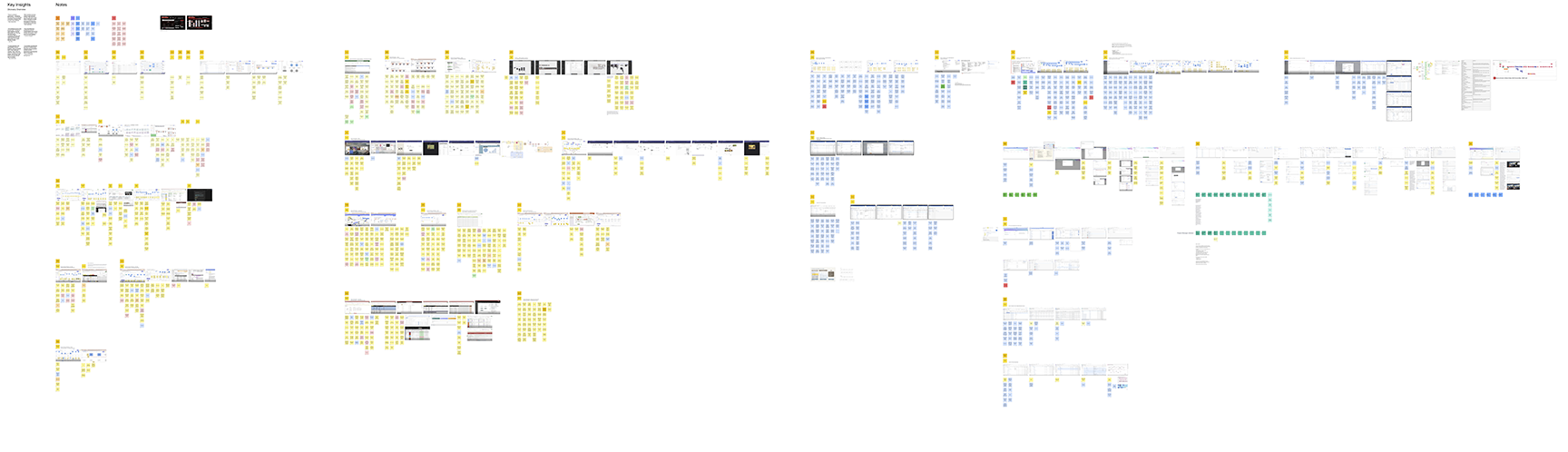
Stakeholder Workshops
Over 30 workshops and numerous group working sessions were synthesized to inform the development of a comprehensive Content Supply Chain Service Blueprint. Cross-functional experts from Account Management, Project Management, Creative, Localization, Production, and Activation from around the globe were engaged to surface how work is performed today, the challenges encountered, and opportunities to improve the end-to-end content delivery journey. The blueprint examined each phase of the lifecycle, from project intake through close-out and final asset archiving, and was intentionally designed to be client-agnostic, enabling flexibility in the selection of service-providers.
Benefits of the Platform
Increased Speed
The Content Supply Chain enables teams to move from intake to delivery more efficiently by establishing a Single Source of Truth across tools and workflows. By streamlining handoffs and accelerating reviews and approvals, the platform reduces delays and eliminates unnecessary creative rework.
Improved Quality
By integrating proven content creation practices into a unified system, the Content Supply Chain supports higher-quality outcomes at every stage of the process. Clear visibility into requirements, feedback, and approvals helps teams stay aligned, reduces errors, and ensures that creative work meets both brand standards and client expectations.
Reduced Context Switching
The Content Supply Chain minimizes friction by consolidating communication, assets, and decision-making into a cohesive ecosystem. Fewer tools and clearer workflows reduce cognitive load for teams, enabling them to stay focused on delivering great work rather than navigating disconnected systems.
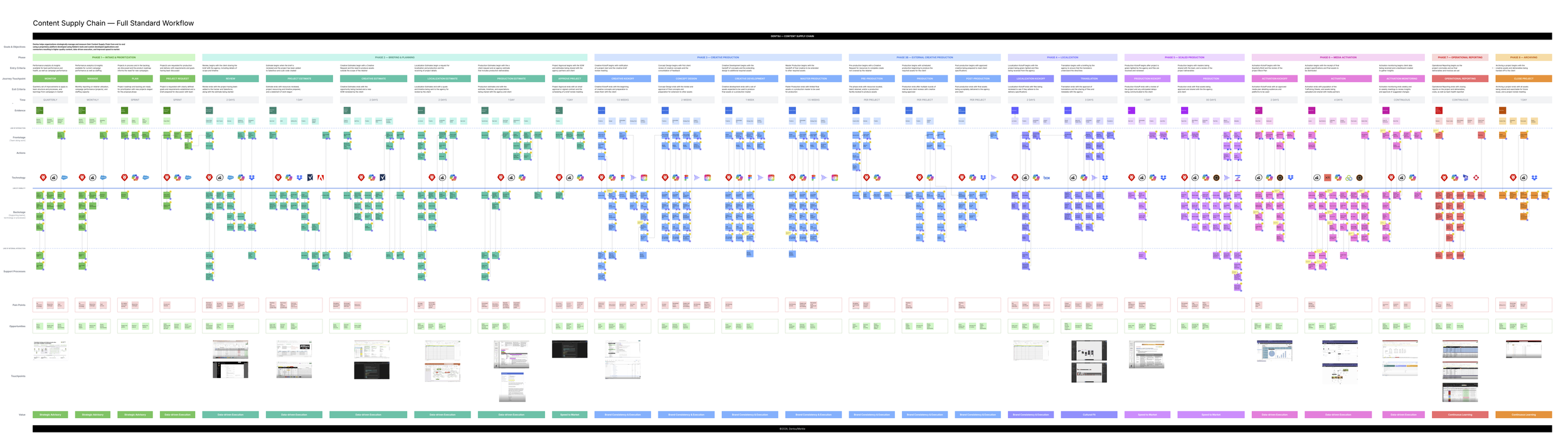
Drawing on insights from the workshop sessions, the end-to-end journey was mapped from Intake through Archiving. Nine distinct phases were identified, including separate phases for internal and external creative, to account for differences in workflows, reviews, and approval processes. Key pain points and improvement opportunities were surfaced, and representative examples of existing tools were incorporated into the foundational blueprint. The journey was intentionally abstracted to ensure applicability across clients, with the expectation that organizations would tailor the model to fit their specific processes and operating contexts.
Our Three Personas
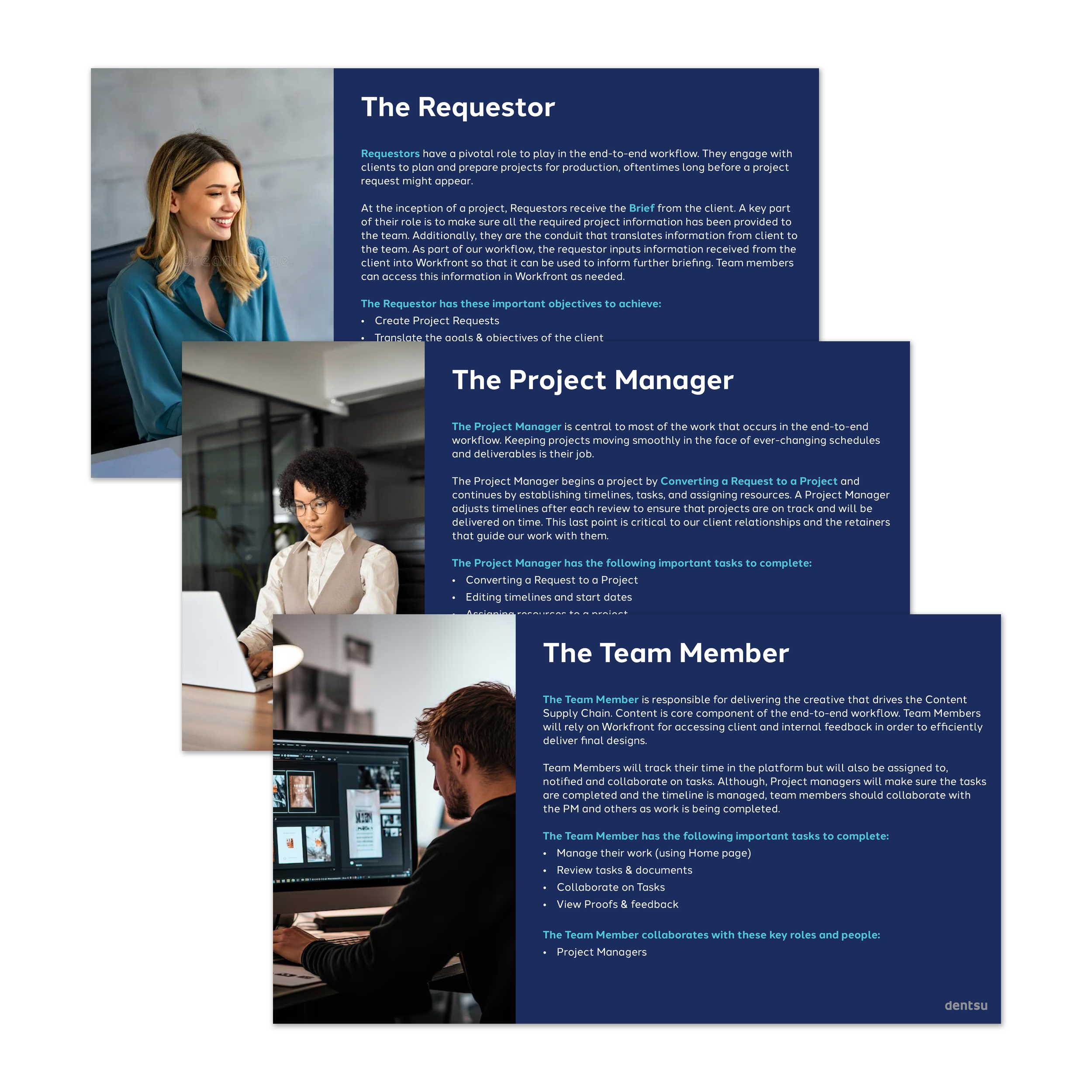
Using insights synthesized from the workshop sessions, personas were developed to represent the three primary roles involved in the content delivery process. Each persona includes a concise profile outlining the goals, motivations, and expectations individuals bring to a project. Together, these personas provide a human snapshot of the people responsible for delivering the services mapped in the Service Blueprint—reinforcing the idea that services are ultimately delivered by people, not systems.
The three personas included:
The Requestor/Approver: typically the client partner
The Project Manager: essential to the project journey
The Team Member: the team completing the creative work
Blueprint Variations
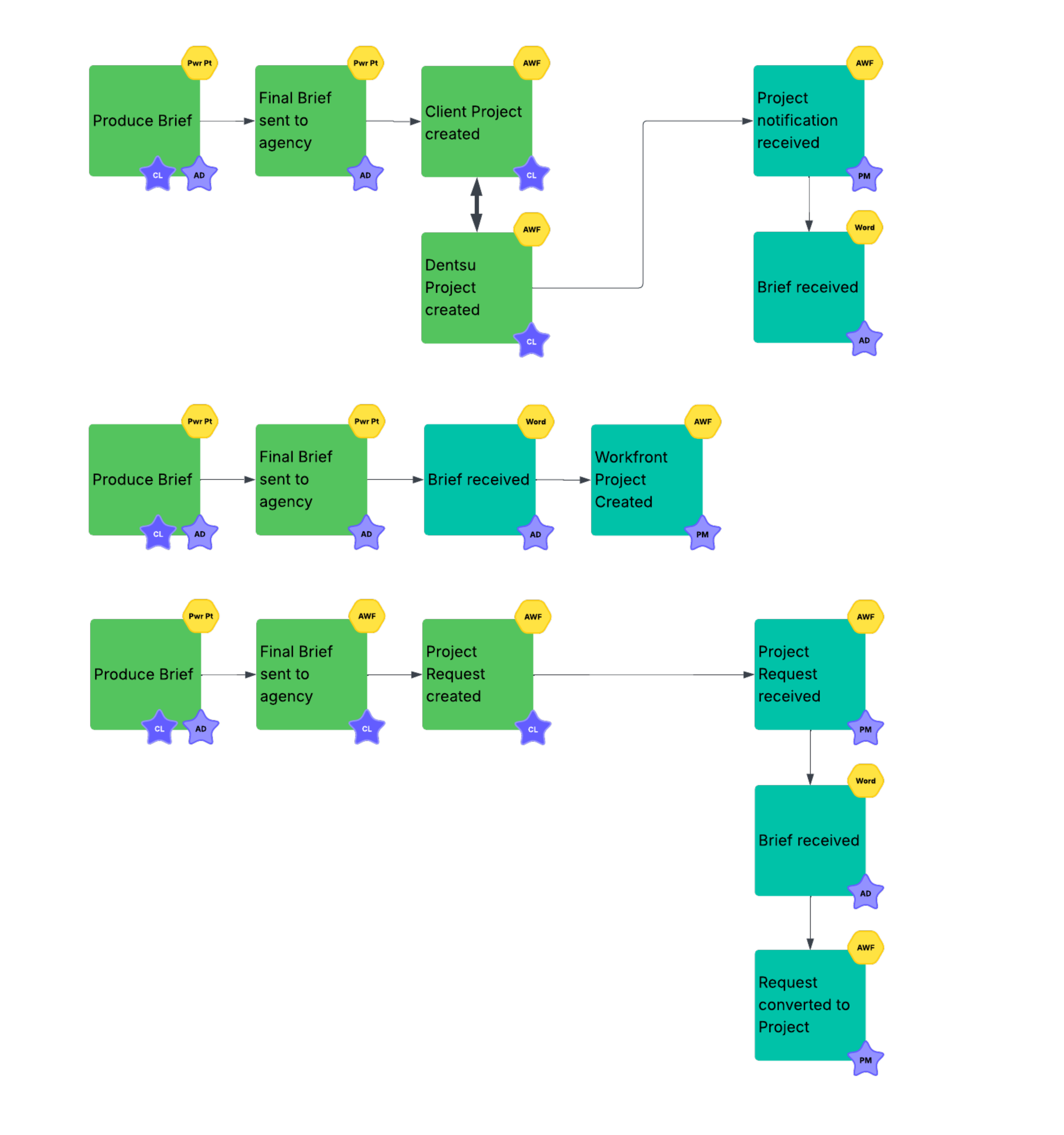
Multiple variations of the Service Blueprint were developed to accommodate differing client workflows and operational contexts. For example, Adobe teams may manage projects using Workfront or rely on legacy, non-automated processes, while Microsoft follows a distinct, standardized workflow. Variations in creative development can also require context-specific approaches, and not all engagements include Localization or Production phases. These differences were intentionally documented, and additional blueprint variants were created to support stakeholder conversations and inform the development of the Playbooks.
Blueprint variations include:
Standard Workflow with automations connecting client Workfront instances with Dentsu instances
Alternate Workflow where Workfront is not used by the client team
Microsoft AOR Workflow where project requests are converted to Workfront Projects
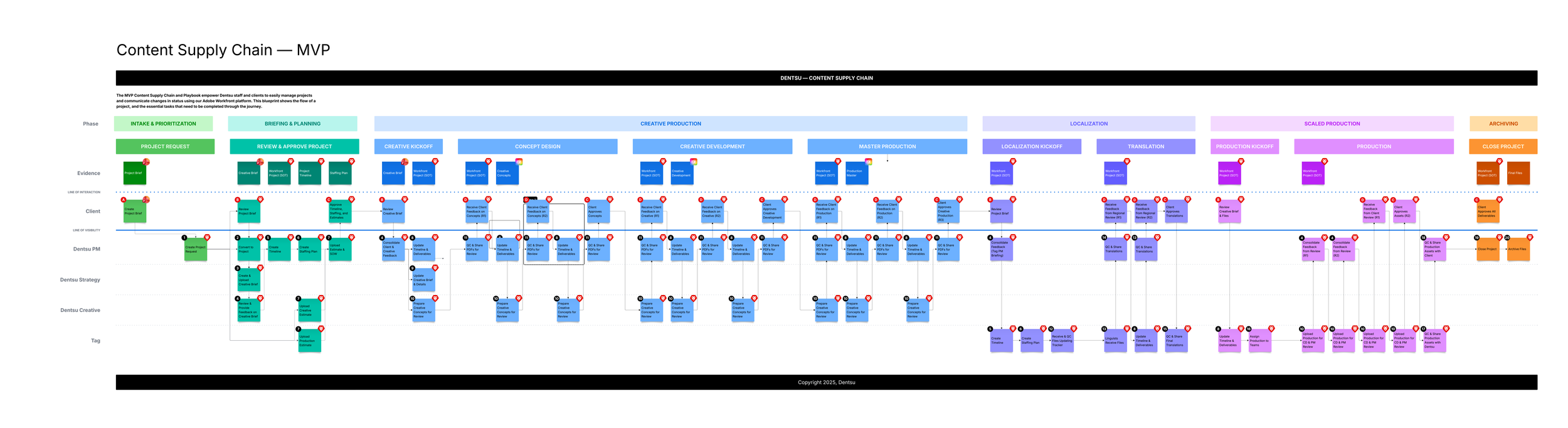
The MVP Service Blueprint represents a streamlined set of capabilities required to initiate engagement with a new client. This initial release, scheduled for delivery to Microsoft in early 2026, will support their content initiatives by providing a clear view of the end-to-end content delivery lifecycle. While not every phase or detailed step is included, the blueprint captures the complete journey at an appropriate level of abstraction and is designed to clearly communicate the process to stakeholders who may not be deeply familiar with the underlying work.
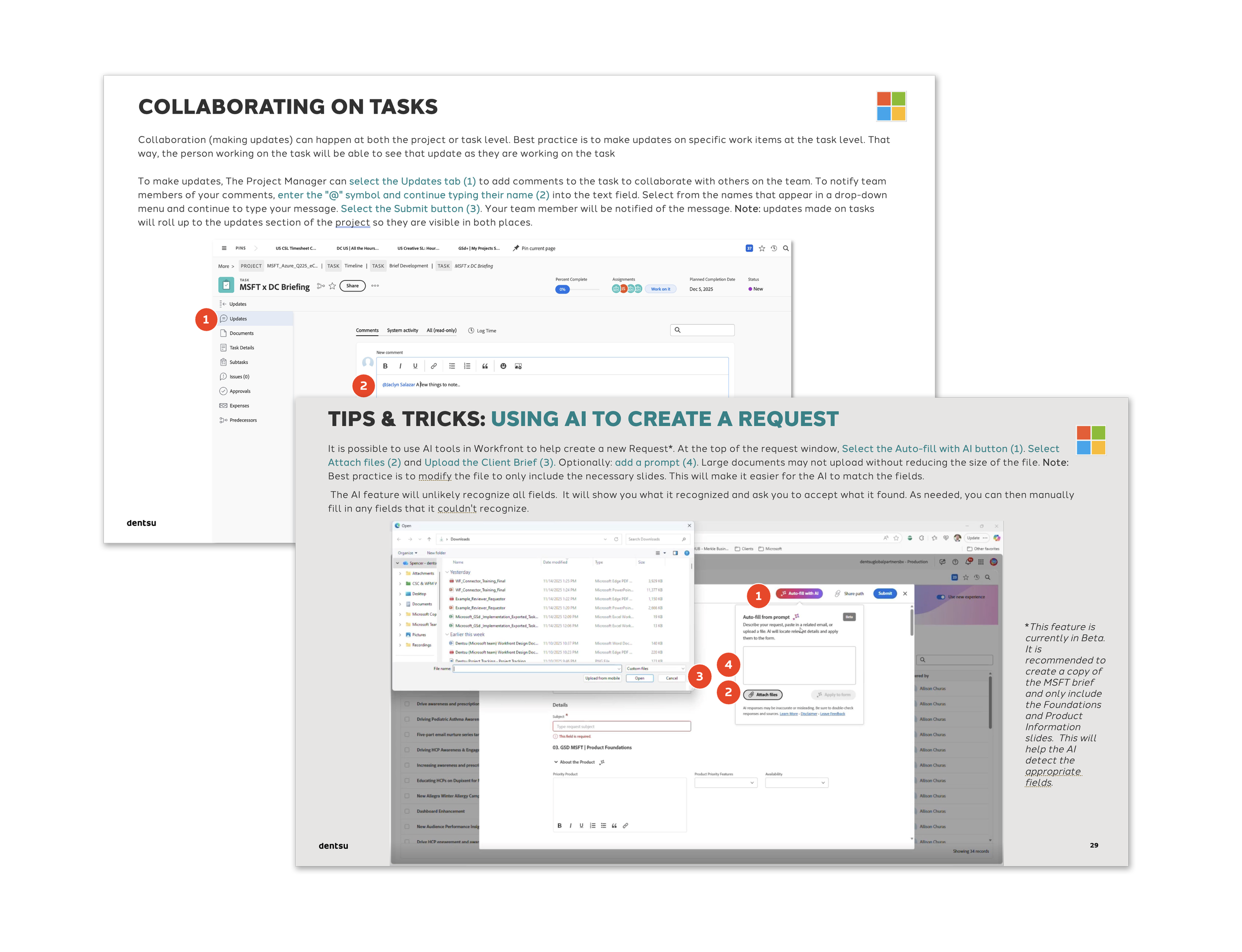
The Playbooks
Persona-specific Playbooks were created for each client — Adobe and Microsoft — tailored to their respective workflows and ways of working. Each Playbook outlined the key responsibilities and tasks relevant to that persona, while also providing practical guidance, including tips and best practices for using Workfront to manage projects effectively.
Playbooks support workflow adoption:
Role clarity drives adoption: Aligning guidance to specific personas reduced ambiguity and helped individuals quickly understand their responsibilities within the workflow.
Workflow-specific enablement matters: Customizing Playbooks to each client’s operational model increased relevance and usability, supporting faster onboarding and consistent execution.
Tools require context, not training alone: Embedding Workfront tips directly into the Playbooks connected tooling guidance to real project tasks, improving day-to-day effectiveness rather than treating tools as standalone systems.
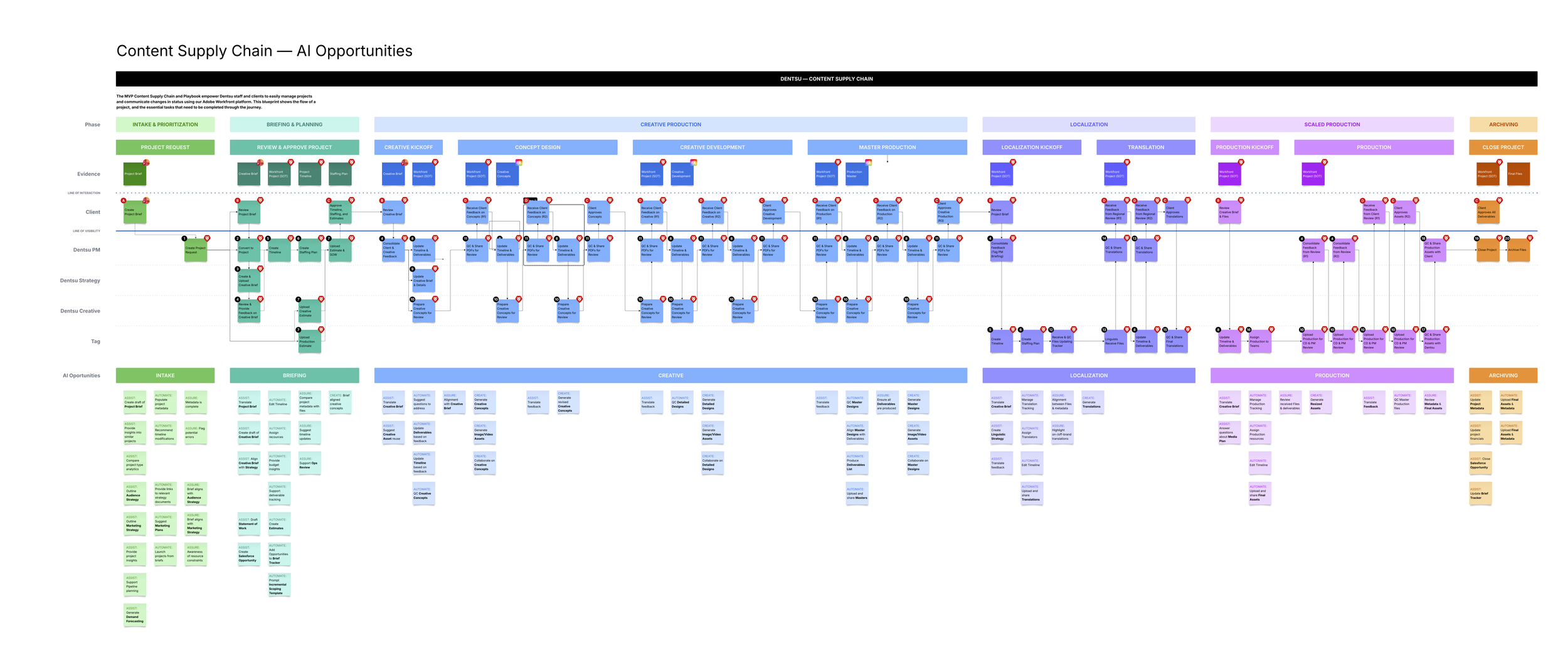
This Service Blueprint highlights key opportunities where AI can augment the workflow by reducing manual effort, improving decision-making, and increasing overall efficiency across the content lifecycle. Potential applications include automating intake processes and project replication, accelerating reviews and approvals, surfacing project insights in real time, and enabling smarter content reuse through pattern recognition and metadata. By embedding AI thoughtfully at moments of highest friction or cognitive load, the blueprint illustrates how emerging capabilities can support teams without disrupting established ways of working—enhancing both speed and quality while keeping humans firmly in control of critical decisions.
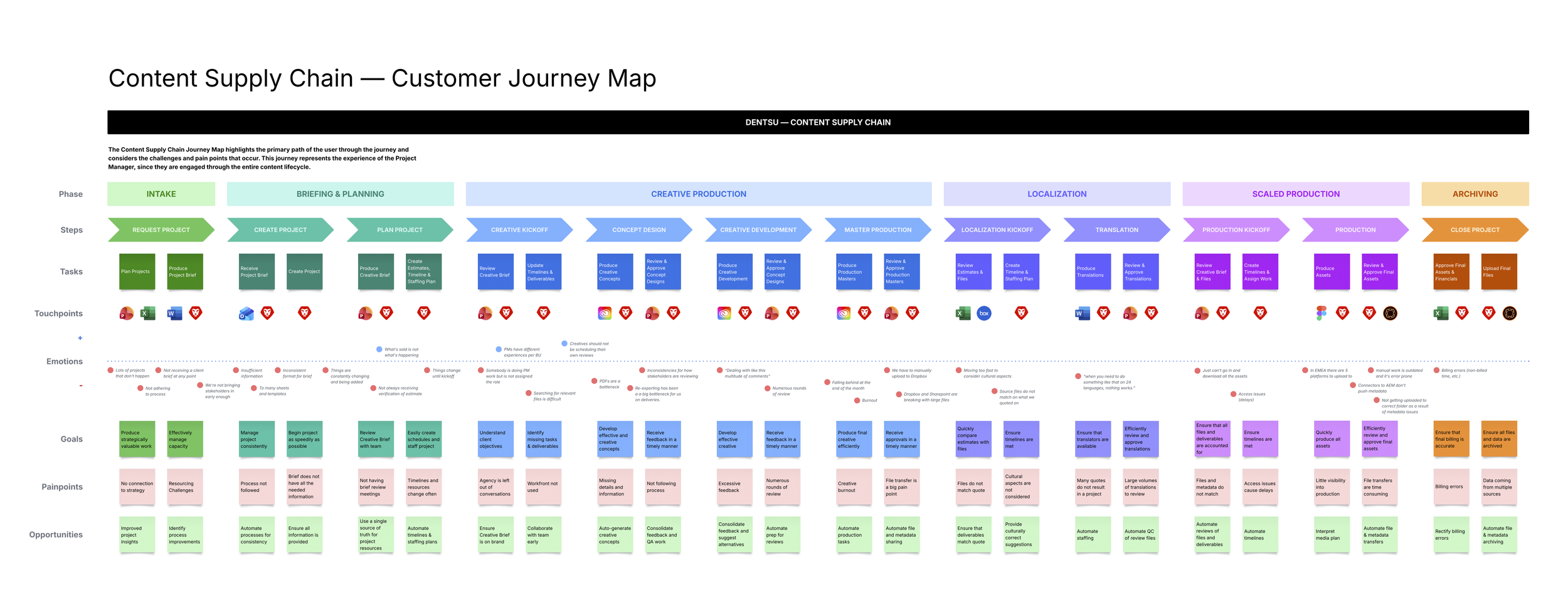
This customer journey map example illustrates how a client experiences the content delivery process from initial request through final delivery, making visible the touchpoints, expectations, and moments that shape their perception of value. By mapping actions, emotions, and interactions alongside supporting systems and services, the journey provides a shared understanding of where the experience succeeds and where friction occurs. It serves as a practical tool for aligning teams around the client perspective, identifying opportunities to improve communication and responsiveness, and informing targeted enhancements that strengthen trust and satisfaction over time.
The Value Proposition
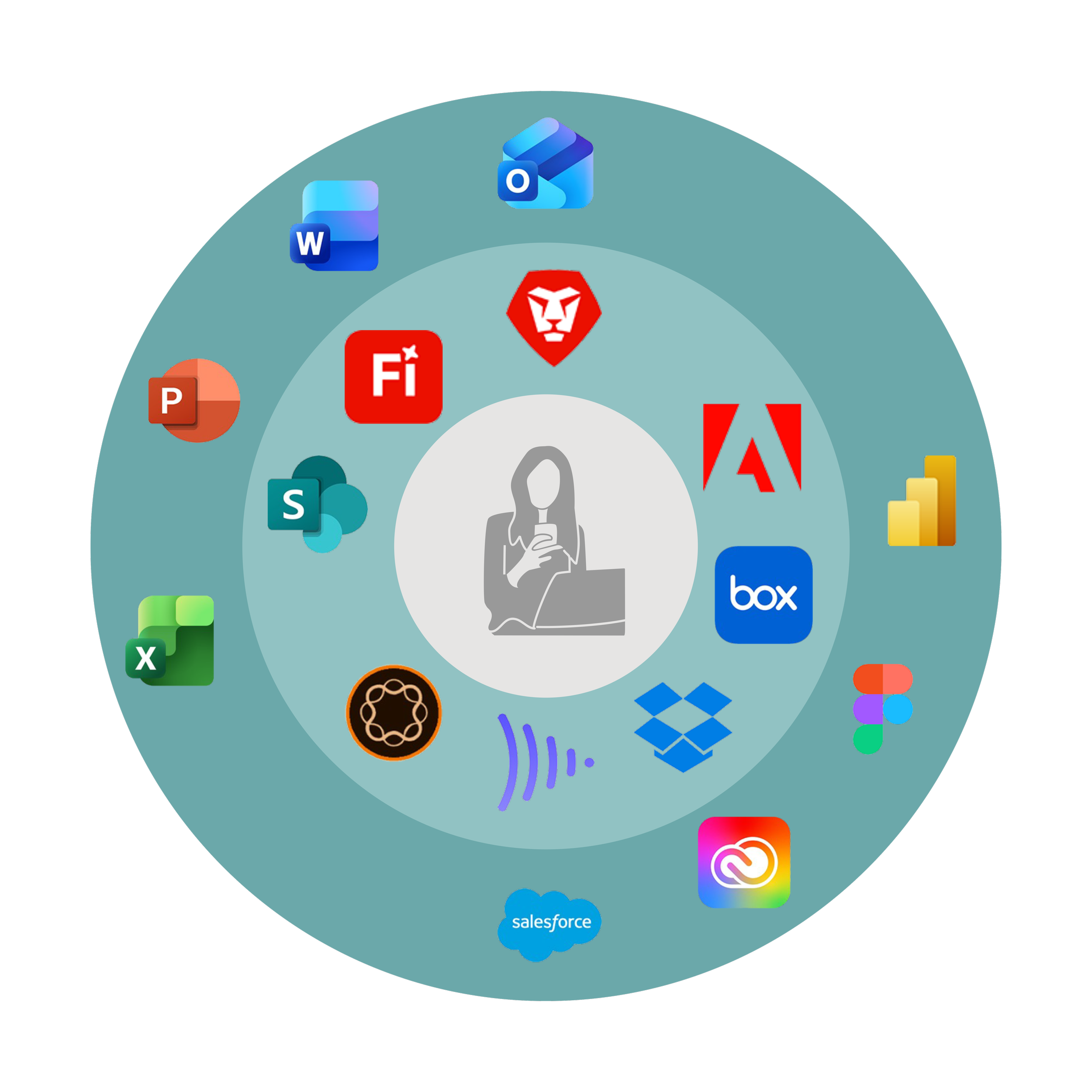
Modernizing the Content Supply Chain requires an integrated strategy that aligns people, processes, and technology to deliver content faster, more efficiently, and at scale. Today, organizations struggle with fragmented tools and workflows, slow intake and delivery cycles, limited visibility into work, costs, and performance, and content models that do not scale. Too often, improvement efforts focus narrowly on tools, resulting in automation that overlooks the needs of the people doing the work.
Dentsu addresses these challenges with a user-centered platform that optimizes content delivery end to end. By integrating with the systems organizations already use, the Content Supply Chain enables scalable content production at lower cost and higher velocity—while keeping human workflows, decision-making, and quality at the core.
Service Offerings
Dentsu partners with organizations to design and deliver the right Content Supply Chain for their content marketing needs. Our services are tailored to align with each client’s operating model, maturity, and technology ecosystem—ensuring solutions are practical, scalable, and grounded in how teams actually work.
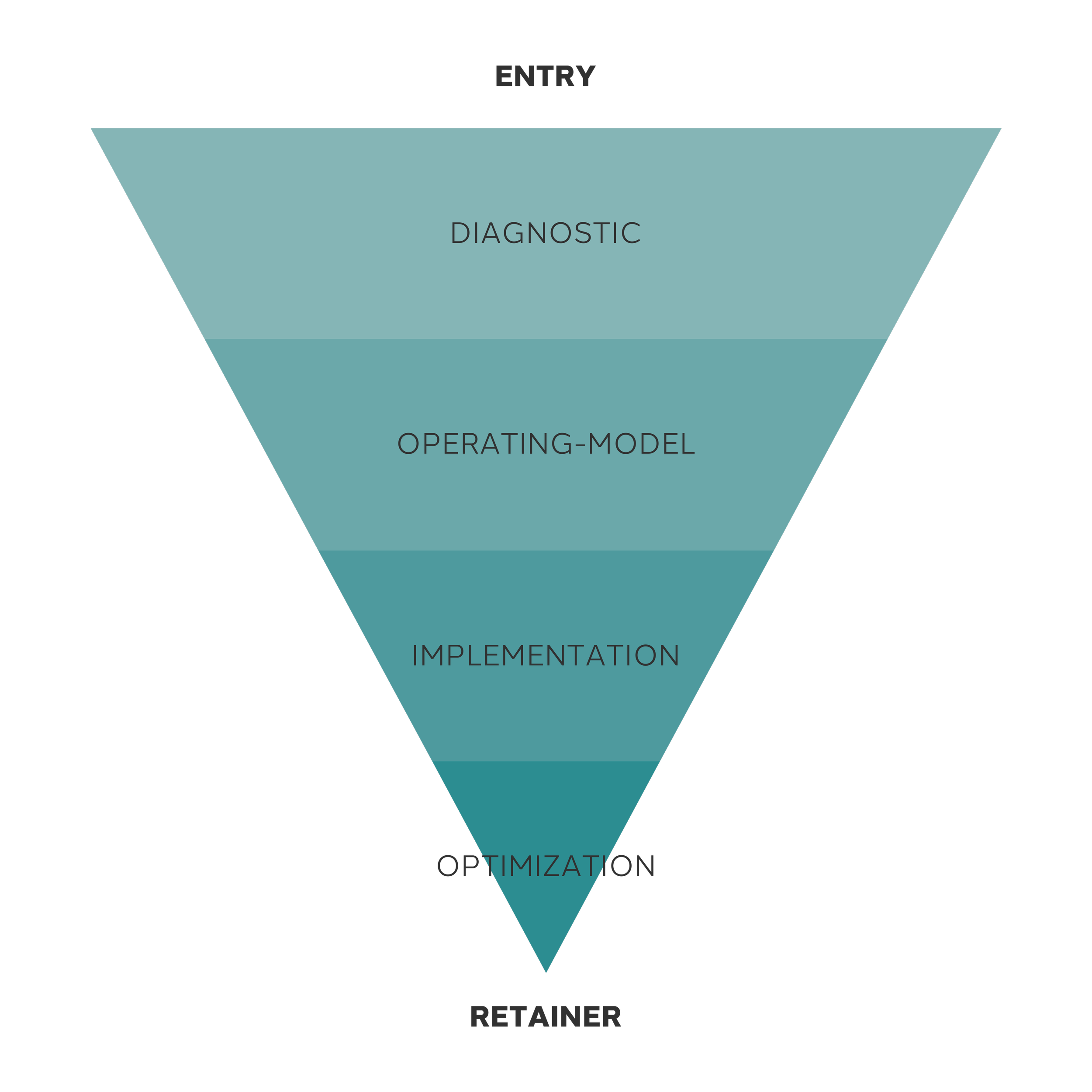
Service levels:
Diagnostic (Entry): An assessment of the current state that identifies key challenges and opportunities, delivering quick wins alongside a prioritized product and capability roadmap.
Operating Model: Definition of the end-to-end content delivery model, including Service Blueprints, intake processes, workflows, and platform recommendations supported by a scalable architecture.
Implementation: Execution of the operating model through workflow automation, platform integration, and pilot use cases that validate value and inform broader rollout.
Optimization (Retainer): Ongoing partnership focused on Content Supply Chain strategy, performance tracking, governance, and a forward-looking automation roadmap.
Dentsu has delivered Content Supply Chain implementations for industry-leading organizations, including Adobe and Microsoft. These engagements demonstrate how a user-centered approach can accelerate speed to market, improve content quality, and reduce operational costs at scale.
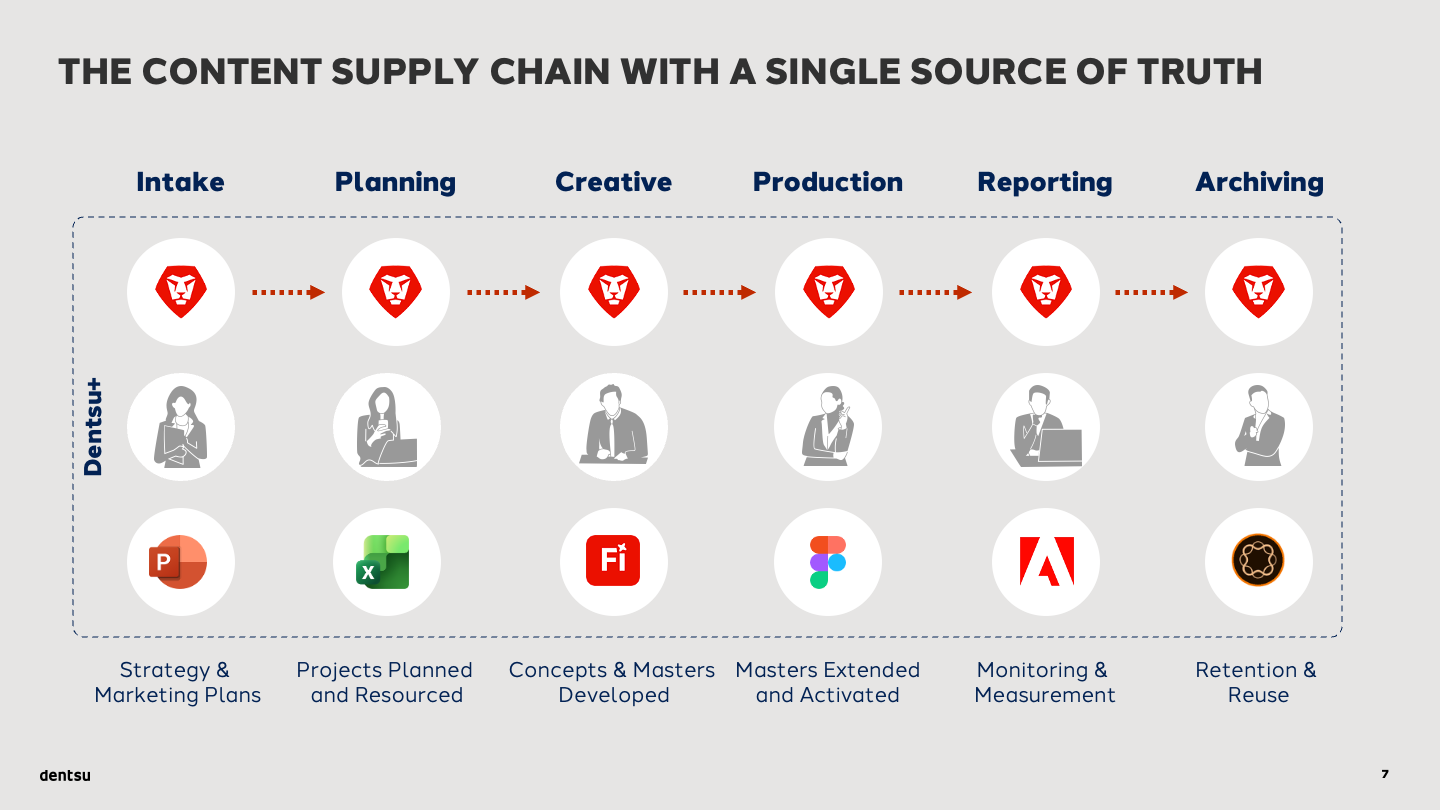
The Dentsu Content Supply Chain delivers value to clients by leveraging project data insights to inform decisions and enabling content reuse across initiatives.
The Value Provided by the Dentsu Content Supply Chain